

Why do avoidants come back? They pulled away, maybe even ended it coldly. And now, weeks or months later, there’s suddenly a message. Or you’re in the middle of no contact and keep wondering if it will ever come.
I’m a healed avoidant. I broke up five long-term relationships in the past decade before I worked through my patterns with four different therapists. Most explanations you’ll find about this come from the partner’s side. Here I want to show you what actually happens inside the avoidant, because I’ve been that person.
You’ll understand the three honest reasons avoidants come back and the stages they go through after a breakup. Then we’ll look at what to do and what to say when an avoidant comes back.
But the most important part is about you. The moment an avoidant comes back, the power shifts to your side, and most partners give it away in the very first minute. We’ll get there.
The short version
- Avoidants usually come back for one of three reasons: they really want you back, they miss the comfort of a relationship as a safety net, or they’re confused about what they feel.
- Their love doesn’t disappear. In a committed relationship it gets buried under anxiety, and after the breakup, when the pressure is gone, it comes back up.
- Many avoidants reach out again after no contact, often with a casual, low-stakes message somewhere between one and four months after the breakup.
- When an avoidant comes back, you have the power. Don’t open your arms right away. Ask one real question: why are you coming back?
- Only consider taking them back if they show real awareness and do the work. Either way you win, because you used the time to come back to yourself.
Why Do Avoidants Come Back?
From my own experience, there are three honest reasons. Sometimes they really want you back. Sometimes they miss the comfort of a relationship more than they miss you. And sometimes they’re simply confused about what they feel.
I went through all three in my previous relationships. So let me show you what happens inside the avoidant’s mind in each of them.
I also talk through these three pathways from the inside in this video:
1. They Actually Want You Back
This might be the one you’d least expect. You might think: avoidants behave immaturely and push people away, so they probably don’t love me that much anyway. You’ll even hear experts say that avoidants simply love less.
As an avoidant myself, I don’t believe that’s true. Avoidants have those feelings too, from deep affection to the butterflies in your stomach at the beginning. Many avoidants I know fall in love intensely. I felt that deep kind of love for the very first time in kindergarten, believe it or not.
So here’s my hypothesis: in an avoidant, those feelings are buried under a huge pile of poop.
Yes, really. Once the relationship gets committed, all the anxiety comes up: the fear of being engulfed, the fear of opening up and being vulnerable. That pressure squeezes the beautiful feelings down until they can’t access them anymore.
And that explains why they come back. After the breakup and some time in no contact, the pile is gone. They dig through it, and the feelings come back up. Suddenly they realize: I actually want them back, and I never really wanted to break up.
When it’s this pathway, you’ll see it in their actions. They work on themselves and dig through their anxieties to make a real relationship possible. And it can work: after my own therapy, I feel that love intensely in a committed relationship too.
2. They Miss The Safety Net
The second pathway is different. They didn’t really want to commit. What they want is security and comfort, the regulation a relationship gives them.
They miss the relationship as a safety net. They don’t miss the actual person.
It’s nice not to be alone sometimes. It’s nice to have the chance of sex sometimes. And the idea of a relationship with you becomes a projection screen for everything they hope for.
Many avoidants grew up with caregivers who never truly saw or heard them. So close relationships came to feel exhausting. But like every child, they kept a tiny spark of hope: a missing puzzle piece, a deep longing to be seen and to be taken as they are.
That spark is what they make huge and project onto another person. They build an illusion of a relationship with you, and the illusion itself comforts and regulates them. This kind of infatuation that lives mostly in the imagination is called limerence, and it happens to all kinds of people, not just avoidants.
If you realize it’s this pathway, then honestly, I would run. Don’t go into a relationship just because someone wants to regulate through you.
3. They’re Confused About What They Feel
The third pathway is the one I lived for my entire relationship life, and I think it’s the least understood.
For most avoidants, it was never clear what they want or need in a relationship. It usually starts early: whenever they expressed a need or an emotion, they were criticized or even punished. Whenever they asked for help, they were met with hostility or rejection.
This is about the deeper needs, like: I need comfort. Or: I’m sad today, and I need someone to talk to.
Whenever an avoidant wants to go to their partner and say “I feel so sad today, can we talk?”, an old anxiety kicks in: they’ll judge me, they’ll reject me. Feeling weak must be a bad thing.
So there’s a constant inner conflict. One part of them longs for connection and closeness. Another part, the brain’s alarm system, keeps trying to protect them from getting hurt again. That ambivalence creates intense confusion and frustration, and it’s why they can leave and come back, and leave again.
I’m not saying this makes it okay. Pushing people away and creating on-off cycles hurts. Every avoidant needs to become aware of it and take responsibility for it. That’s non-negotiable.
Want to Know How To Respond When They Come Back?
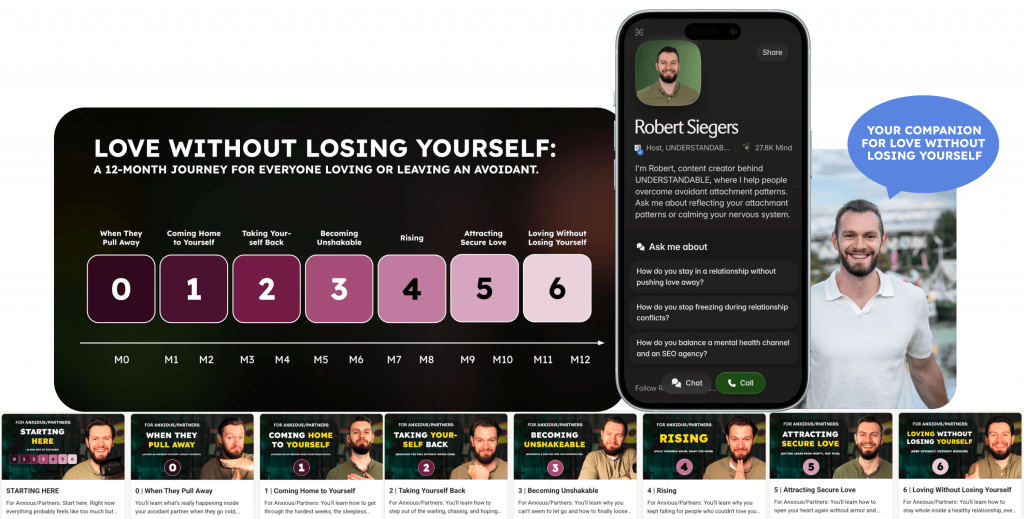
I’m a recovered avoidant and created a 12-month program for everyone loving or leaving an avoidant. Your roadmap for love without losing yourself.
- 24/7 access to my AI companion for your exact situation, trained on 1 M+ words about push-pull dynamics
- 40+ guiding courses with exercises from my own therapy work
- One clear path, month by month, back to yourself
The Stages Of An Avoidant Coming Back
If you want to understand when and how an avoidant comes back, it helps to know the stages they usually go through. I went through them myself in my first relationships, and there’s one stage before the breakup that most people overlook.
I walk through every stage, from the inside, in this video:
It Starts Before The Breakup
My first long-term relationship lasted nearly three years. Looking back, it was lovely. We had great energy together. But slowly, without noticing, I was pulling away.
I started idolizing my single life. I thought I’d feel better single, more like myself, more free. I had this fear of missing out, that there might be better partners out there I hadn’t met yet. And I threw myself into my hobbies, reading and working out for hours.
All of that slowly became more important than her. It’s really painful to admit that today, but that was my reality back then.
What I was doing is called deactivating. The brain protects you from getting hurt and from having to show up vulnerable by making your partner less important. You lose interest and slowly go numb.
Back then I thought: this is just how I am, I’m not interested anymore. Today I know it was my brain applying a trick to pull me out of the relationship. All avoidants tie closeness to danger, and most of them have no idea they’re doing it.
So I ended it. She’s not the right partner, I told myself. I don’t have feelings anymore. I feel the ick.
That’s exactly what avoidants tell themselves, over and over. It’s self-sabotage, though not out of bad intent. She was a really loving woman, and there was no real reason to leave.
In most relationships there’s more conflict than in mine, especially with an anxious partner. Old wounds get triggered, and then the avoidant has what feels like a real reason: we always fight, it’s too much, this is toxic.
For an avoidant, conflict feels like the end of the world. Usually what drives them is the need to protect themselves, because they never learned how to handle conflict.
I still feel incredibly hurt when I’m triggered today. The difference is that I don’t end the relationship over it anymore. What I value most with my partner now is stability and feeling like a team.
And if you were the one who ended it, because you couldn’t take the hurt anymore, that’s just as understandable. Working through this pattern is primarily the avoidant’s job. You can give them space to do that work. But don’t take them back just because they return, if they’re not willing to do it.
No Contact, But An Invisible Connection
Stage one is no contact. From the avoidant’s side, there’s usually zero reaching out at first. But there’s still an invisible emotional connection.
At first, I was dealing with what I’d call a vulnerability hangover. Part of me was relieved it was over. I was trying to digest everything, along with the grief and the sadness.
A breakup isn’t easy for an avoidant, even if they don’t show it. I cried a lot after every one of my breakups.
Part of that crying was frustration and confusion. Why didn’t it work out, when the relationship was so good?
And slowly, tiny sparks came up. I miss her. Was I wrong, or is she really not the right person? I was trying to convince myself to go back and to move on at the same time.
On the outside, this is when avoidants check your profiles and ask mutual friends about you. Some even hang out in the park near your place, secretly hoping you’ll walk by.
Looking back, some of that crosses into stalking, and I don’t want to romanticize it. What drives it is a longing: I want to feel what it’s like to be close to you again. They want that relationship, but they can’t let themselves have it, because they don’t see how much they’re overprotecting themselves.
Will An Avoidant Come Back After No Contact?
Often, yes. In stage two, usually somewhere between one and four months after the breakup, the first attempts at contact happen. But they’re almost always low-stakes, like a casual text or a meme. Never a confession or an apology.
It’s a toe in the water. They’re checking where you stand: if you’ve met someone new, or if you’re doing fine without them. Often they’ll suggest being friends, just to increase contact.
Inside, they want nothing more than a warm reaction from you:
“You’re totally okay the way you are. I love you, and I’ll take you back. Come here, let me give you a hug.”
That’s the warmth they long for beneath all of it, while they still swing between wanting you and being full of anxiety. That’s how it went for me too. I started texting her again: maybe we can be friends, maybe we can see each other.
If you’re on the other side, this is the moment to keep no contact alive. The more breadcrumbs you give them, the more you fuel their desire to come back without doing the work. I wrote more about this pattern in my article on avoidant breadcrumbing.
Often they need to really feel the loss to understand what they had, and that can only happen if the way back isn’t too easy. If you want to say something, you can set a clear boundary:
“You hurt me. A few casual messages don’t make up for that. And unless you’ve worked on your patterns, I’m not taking you back.”
Why Do Avoidants Come Back When You Pull Away?
Because distance lowers the pressure. When you pull away, their protection mechanism cools down and the vulnerability hangover fades. Without the pressure, they can dig through the pile, and the feelings from the beginning come back up.
That’s stage three, usually after three or four months, although it’s different for everyone. Now they’re ready to see you. Let’s meet. Let’s go on a date.
And the spark from the beginning is back, with all the attraction and the butterflies. If you’re avoidant yourself, you know exactly what I mean.
But this stage is full of uncertainty. Is this real commitment, or just another dating phase? The triggers aren’t active yet, so it all feels great.
There’s no grand gesture, though. Commitment doesn’t look like commitment here. They might make short-term plans, but they don’t talk about a future.
The Moment Of Decision
Stage four is the most important one, and it can go two ways.
The first way is a dead end. They fall back into their old patterns. They’re not even aware they’re avoidant, and they still believe you’re simply not the right person. Then it ends here.
That was me back then. I didn’t understand my patterns, so in stage four I pulled the emergency brake and broke up for good.
The second way is a clear decision. The avoidant realizes that the problem lives in their own patterns, and that without change, they’ll end up in the same spot with anyone. And they decide: I want to work on this.
That was me in my current relationship. After my first therapy, I met my partner, and all of the triggers came back. I was scared as hell to commit. I saw myself pulling away again and idolizing my single life.
And I saw her suffering already. So I told myself: I will never suffer like this again, and I will never make my partner suffer again. I went back to therapy, because I wanted to focus on love in my life, and maybe have a family with her one day.
If you see your partner make that kind of decision, there is real hope. That’s when an avoidant starts to understand that idolizing the single life, searching for the perfect partner and guarding their freedom were all part of the same protection mechanism.
When An Avoidant Comes Back, You Have The Power
Being rejected by an avoidant hurts. After all the intense highs and lows, it can hurt tremendously. And that’s okay. You don’t have to push that hurt away.
It also helps to understand why they rejected you. When closeness and commitment grew, their nervous system tried to protect them from getting hurt again. So they deactivated and pushed you away. Ironically, that’s how they end up hurting the people they’re close to, repeating the pattern from their own childhood.
I don’t want to justify that. It’s unreflected, it hurts, and it’s not okay.
But once you understand it, you might realize: I was never the problem. I was never too needy. I was never too sensitive.
Right after a rejection, many partners feel grief and a deep powerlessness, as if they were at the mercy of the avoidant’s moods. But that weak position can shift faster than you’d expect.
When the avoidant returns, you have the power.
Your reaction in that moment, what you say and the energy you say it with, shapes what happens next. It shapes your future relationships too. And whether they come back or not, what matters most is what you realize about yourself in the time in between.
Two Reactions That Give Your Power Away
The first is an avoidant reaction of your own. You’re so hurt and disappointed that you think: I’ll never trust anyone again. That’s understandable.
But if that anger comes from your own wound rather than healthy self-protection, you end up adopting their trauma pattern, and you might avoid secure love later on. Use that energy to set a boundary, and keep your heart open.
The second is an anxious reaction: pure grief, and the belief that it was all your fault. If the rejection hits your worth that hard, you’re still looking for their validation. And if they told you that you were too needy or too dependent, that says a lot about them and very little about you.
How A Secure Person Would React
A secure person would think something like this:
“I’m hurt and really disappointed. Maybe I chose someone who wasn’t able to build a relationship with me, or I was so in love that I didn’t see the red flags. But their rejection says nothing about my value as a person. I can’t control them, but I can control my own life.”
That’s the power position. And you can learn to stand in it.
Want to Know How To Respond When They Come Back?
I’m a recovered avoidant and created a 12-month program for everyone loving or leaving an avoidant. Your roadmap for love without losing yourself.
- 24/7 access to my AI companion for your exact situation, trained on 1 M+ words about push-pull dynamics
- 40+ guiding courses with exercises from my own therapy work
- One clear path, month by month, back to yourself
What To Do When An Avoidant Comes Back
The best time to prepare is during no contact, before they ever reach out. These are the steps I would take. And if they never come back, you’ve still won, because you’ll be much closer to the secure side yourself.
I explain these steps, and what to say first, in this video:
1. Get Clear On Your Standards
Know what you need and what your relational standards are before they come back. The clearer you are, the more confident you’ll feel, and the less their reactions will move you.
Your standards could sound like this:
I want someone who at least tries to do the work. Nobody has to be perfect, but I want someone who tries to see my needs and who is there for me emotionally. And I want someone who tells me honestly where I could do better, instead of just pleasing me.
2. Reconnect With What You Want
Use the time to listen inward and practice standing up for your needs. I’m practicing this myself right now.
Here’s a small exercise. Whenever someone suggests something, pause for a second and ask yourself what you actually want. Do I want a coffee right now, or would I rather have tea? Do I want after-work drinks tonight, or would I rather go to the gym?
That sounds simple. It isn’t. If you’ve always focused on managing other people’s moods, you got really good at it, and you lost track of your own wants along the way. So try not to say yes automatically.
3. Build The Other Legs Of Your Chair
Make the other areas of your life strong again. Start the sport you always wanted to do, or get the dog you’ve always wanted. And make time for friends and family, especially if you neglected them during the relationship.
I always use the picture of a chair for this. Many people in a relationship with an avoidant sit on a chair with only one leg: the relationship. When that leg breaks away, they fall hard. I write more about this in my article on how to get over an avoidant.
When avoidants I was dating ghosted me or didn’t reply for days, I forced myself to go to the gym and to see my friends, and they really helped me. If you don’t feel like it, force yourself a little. It brings back the feeling of being alive and independent.
What To Say When An Avoidant Comes Back
When an avoidant comes back, it’s usually because the relationship felt convenient. They missed the good times and the emotional regulation. So remember in that moment: you have the power.
Most partners don’t use it. They get excited and relieved, and they open their arms wide: finally, I’ve counted every single day. If you take them back with that energy, it signals one thing: you didn’t stand up for yourself. And if you didn’t stand up for yourself during no contact, why would they believe anything will change in the relationship?
Instead, turn them down with grace. Stay calm and clear, and keep living the life you built in the meantime. You’re not cold to them, and you’re not punishing them. You acknowledge that they came back, but you don’t reward it.
And then you ask one real question:
“Why are you coming back?”
Listen closely to the answer. An avoidant who actually did the work will come back with awareness. They might say something like:
“I realized I was the problem. You were never the problem. I told you that you were too needy and too dependent, and I was wrong. I went to therapy, I understand now why I pull away, and I don’t want to do that anymore.”
That’s very different from “I missed you, let’s hang out,” or “I was bored being alone,” or “We had such great chemistry, let’s see where it goes.” If that’s the answer, you can simply say: “No, sorry. I’m not available for that anymore.”
You don’t need to justify it. In that moment, your only job is to stay grounded in what you learned about yourself during no contact.
Watch What Happens Next
The real test comes after. Do they follow through with actual change? Are they going to therapy and doing the work? Or do they fall back into their old patterns within a few weeks?
My first therapist always said: those heavy fights and push-pull cycles only happen in relationships where at least one person isn’t aware of their patterns. One person is enough. If both of you do the work, I believe an anxious-avoidant relationship can actually work quite well.
So meet each other with brutal honesty and with compassion. Set the boundary when something isn’t okay, and still try to understand them.
If You’re The One Who Keeps Coming Back
Maybe you’re reading this as the avoidant. If you come back only for comfort, or because you’re confused about what you feel, take it as a sign to work on yourself. Find out what triggers you in relationships and which anxieties sit beneath it. A good therapist can help you with that.
It’s possible to work through these patterns and become more securely attached. I got there too.
You Win Either Way
Whether they come back or not matters less than it feels right now. If you used this time to come back to yourself and to see that you were never the problem, you’ve already won. So if they text you tonight, ask yourself: am I answering from fear, or from what I know I deserve?
Want to Know How To Respond When They Come Back?
I’m a recovered avoidant and created a 12-month program for everyone loving or leaving an avoidant. Your roadmap for love without losing yourself.
- 24/7 access to my AI companion for your exact situation, trained on 1 M+ words about push-pull dynamics
- 40+ guiding courses with exercises from my own therapy work
- One clear path, month by month, back to yourself