

Learning how to get over an avoidant can feel harder than any breakup you’ve been through before. Part of you knows it’s better to let them go. Another part keeps replaying how it felt in the beginning and wonders if you gave up too soon.
I know this from both sides. I lived with avoidant patterns myself and worked through them in therapy. And I also know what it’s like to be the one who can’t let go of an avoidant.
So here I’ll show you why this kind of connection feels so intense and why your mind keeps searching for the mistake you made. We’ll look at what to do when an avoidant ex keeps coming back. And then I’ll walk you through six phases of healing, from the first raw weeks after the breakup to a relationship where you can love without losing yourself.
But there’s one central mechanism that makes letting go so much easier once you see it: the hope that keeps you attached, and where that hope first came from. We’ll get there.
The short version
- The early intensity with an avoidant can feel like finding your soulmate. Often it comes from two old wounds pulling at each other like magnets.
- What keeps you stuck after the breakup is hope. Blaming yourself keeps that hope alive, because if it was your fault, you were still in control.
- Their distance says nothing about your worth. Whether they could commit was never in your hands.
- When an avoidant ex keeps coming back, most of them haven’t changed. Only a small group returns because they’re truly ready to commit.
- Healing takes time and happens in phases, from coming home to yourself in the first weeks to dating from self-worth instead of fear about a year later.
Why Is It So Hard To Get Over An Avoidant?
Because the connection was built on intensity, and intensity feels a lot like love. On top of that, something underneath the heartbreak keeps you hoping, even when you know better.
Breakups hurt by nature. Most of us have been through at least one. But when the other person was avoidant, letting go is usually even harder.
The word I hear most often in my community for this kind of connection is “soulmate.” People describe it as magnetic, more intense than anything they’ve felt before.
Why The Beginning Felt Like Meeting Your Soulmate
There’s a reason the beginning felt so good. In the first days and weeks of dating, before there’s any real commitment, an avoidant often overcompensates on closeness and connection. That changes later. But at the start, they can be incredibly present.
It goes back to childhood. Many avoidants never got the feeling of being loved unconditionally, of being okay just as they are, with all their needs and vulnerable feelings. Often a caregiver couldn’t handle their own emotions and leaned on the child instead. So the child learned something painful: I’m flawed, and unconditional love isn’t for me.
That leaves a hunger. As adults, many avoidants go looking for the missing piece, someone who will finally love them without conditions. And when they think they’ve found that person in you, they pour everything in. They project their hopes onto you and shower you with affection and attraction.
And you feel seen like never before. Maybe you even thought: this is how love is supposed to feel. Nobody has ever treated me like this.
Here’s the thing, though. Intensity isn’t proof of a secure, loving connection. The real question is whether you met your soulmate, or whether two unhealed nervous systems found each other and snapped together like magnets.
Why Avoidant And Anxious Partners Attract Like Magnets
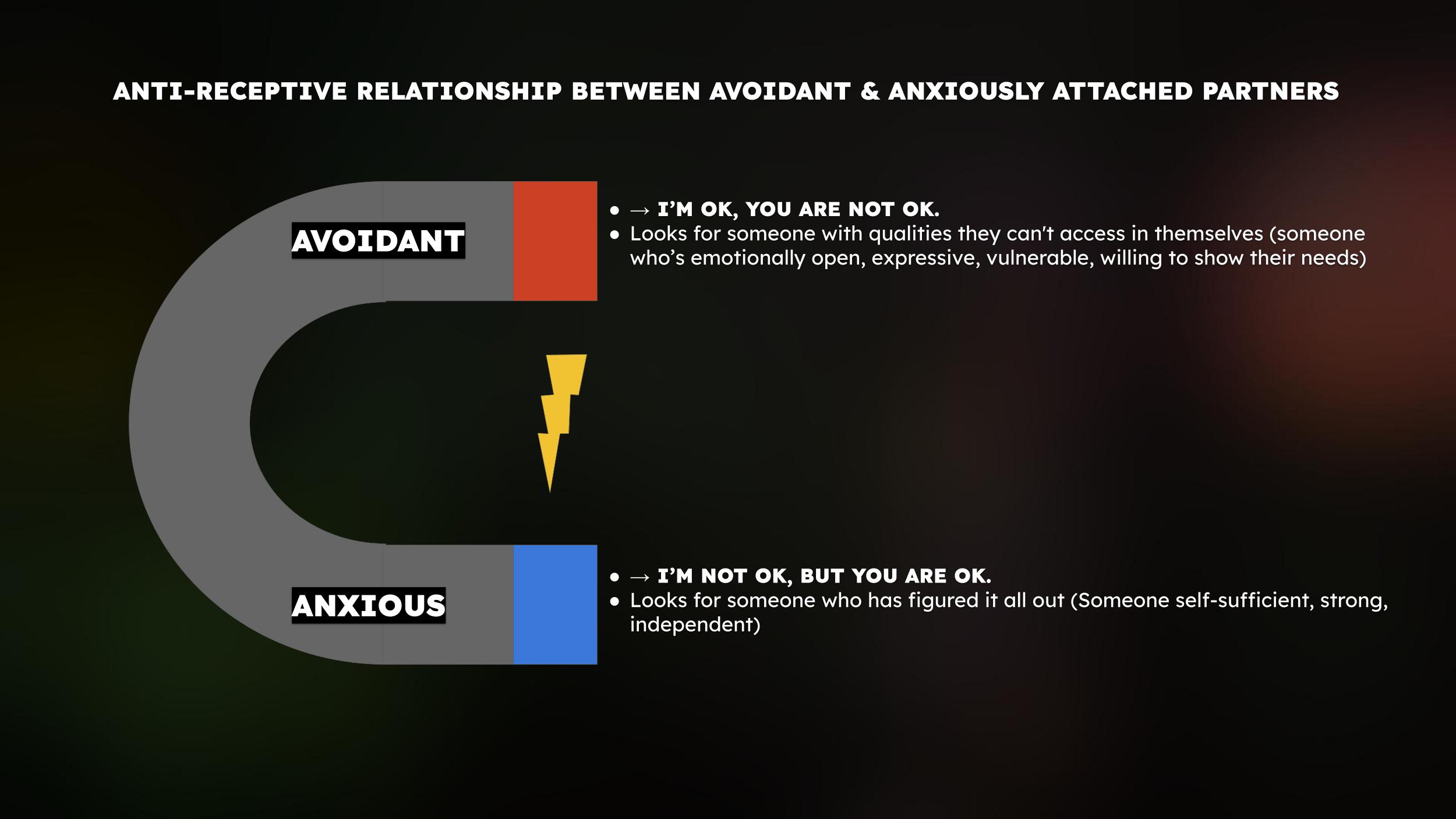
The avoidant learned early on: I’m okay, but other people aren’t. Other people make demands. When I showed vulnerable feelings or asked for help, I was rejected or met with hostility. So I can only rely on myself.
That leaves them missing exactly what they secretly long for. They feel ashamed to be emotionally open, so they’re drawn to someone who is. Someone expressive, who shows what they need and feel without holding back.
And who can do that better than someone on the anxious side? Their early belief is the mirror image: I’m not okay, but you are.
They had to work hard for love and attention, and their caregivers were the gatekeepers of that love. So as adults, they look for a new gatekeeper. Someone strong and independent who seems to have it all figured out.
And where do you find those qualities? In the avoidant partner. So each side finds in the other exactly what it’s missing. That pull can feel like destiny, when what’s really happening is that two old wounds recognize each other.
When I Was The One Who Couldn’t Let Go
I know this pull from the partner side too. When I was younger, I kept falling into exactly this dynamic.
In my early twenties, I dated a woman who seemed so self-sufficient. She had two jobs and her own apartment, with a brand-new couch and a brand-new TV. I admired that so much. I thought: wow, she can really take care of herself.
From the first day, there was this crazy energy between us, and a lot of sexual tension. But she was also hard to reach, with so many other things going on in her life.
Next to her, I felt like a little boy. Completely drawn to her, and at the same time never quite enough. I kept asking myself where I actually stood in her life.
We didn’t meet that many times. The last time, I spent the day working at her place while she was at work, and I cooked dinner for when she got home. Salmon, and a dessert.
When she walked in, she was distant and cold, and she didn’t want to talk. We just ate. I suggested a drink and a walk, since it was such a nice, sunny evening. She said it would be better if I left now.
So I left, and told her to let me know if she wanted to go for a walk on the weekend. After that, she ghosted me. I sent one last message asking what was going on. I never heard from her again.
And I was still in love with her.
What I did next might sound familiar. Night after night, I sat there analyzing everything. Every message I’d sent. Every word I’d said.
I even made mind maps, trying to find the exact moment I’d ruined it. To me it was obvious that I must have done something wrong, and that’s why she wasn’t attracted to me anymore. The more I searched, the needier and clingier I got.
Then one day I told the whole story to two of my best friends at university. They listened, and then they said:
“Robert, you have to understand one thing. We’ve heard this so many times in your dating stories. You didn’t do anything wrong. You don’t even have any influence on whether someone is attracted to you or loves you.”
Something clicked. Why was I so sure it was my fault?
I’ve always been someone who tries to take responsibility for everything. I learned that as a child, and it’s what many avoidants learn: if you just work hard enough on your own, you can fix anything. But some things are simply out of your hands. Whether another person can stay is one of them.
I talk through this whole dynamic, including my own story, in this video:
Want To Get Over An Avoidant Ex And Finally Move On?
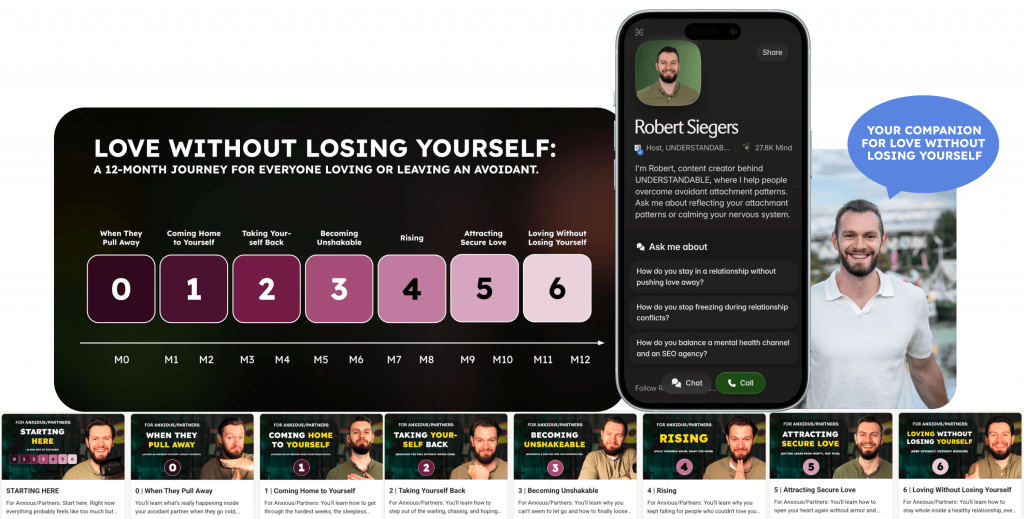
I’m a recovered avoidant and created a 12-month program for everyone loving or leaving an avoidant. Your roadmap for love without losing yourself.
- 24/7 access to my AI companion for your exact situation, trained on 1 M+ words about push-pull dynamics
- 40+ guiding courses with exercises from my own therapy work
- One clear path, month by month, back to yourself
What If Your Avoidant Ex Keeps Coming Back?
Then it helps to understand why they come back, because the reason decides whether there’s anything real to come back to. From what I’ve observed, avoidant exes who return fall into three groups, and only one of them returns to stay.
The first group is the biggest. They come back because they don’t really know what they want and need in a relationship, or what their standards are. They’re torn between two forces. Part of them longs for closeness, while another part gets pulled back by old fear as soon as things get vulnerable, so they withdraw again.
The second group is often younger. They come back because they want you to regulate them. They’ve built a fantasy version of you, someone who will rescue them and fill the missing piece inside. When they’re alone, they feel lonely and unsettled, so they return for the comfort of a relationship without really choosing it.
The third group is the smallest. They come back because they’ve realized they really do love you and want to commit.
With the first two groups, it’s usually better to close the door at some point, even when they return and even when part of you still wants to let them in. Otherwise you end up in an endless on-off cycle, a roller coaster with someone who has no awareness of their own patterns and needs.
If you want a mature, stable relationship between two adults, they’re not your match right now. And that awareness is unlikely to show up in the next few weeks or months. Probably not in the next few years either.
Sometimes the return isn’t even a real return. It’s a meme or a “hey, how are you?” after weeks of silence, with no step toward anything. I wrote about that pattern in detail in my article on avoidant breadcrumbing.
I go deeper into these three groups, and into the full recovery timeline, in this video:
Even when you know all this, their return can still light up hope in you. Maybe you’ve noticed that you keep attracting this kind of person, and that their attention gives you a kind of validation that feels really good.
That’s completely understandable. Of course you long for that connection. But if you want a stable relationship instead of another ride on the roller coaster, it’s worth looking at what that hope is really doing.
The Real Reason You Can’t Let Go
Now to the hope I mentioned at the beginning. To understand it, we have to go back much further than this relationship.
Why Blaming Yourself Feels Safer
Most people who end up with avoidants share one thing from childhood, and I include myself here. A parent who was sometimes present and loving, and sometimes not. A hot and cold pattern, installed long before the first date.
If you grew up with something like that, you learned to hope. One day it will change. One day they’ll love me no matter what. In a way, it’s a wound that looks a lot like the avoidant’s.
For a child, that hope was a lifeline, because it gave you a sense of control. Imagine the alternative: realizing that your parents weren’t really there for you, and that there was nothing you could do about it. For a small child, that would be unbearable.
So it’s easier to believe: it’s me. I’m the problem. Because if it’s my fault, then I can fix it.
That same logic is still running today. When your mind decides the breakup was your fault, it’s quietly telling you that you’re in control. Everything the brain does serves a purpose, even when it hurts.
My mind maps and my nights of analyzing were exactly that: an attempt to feel safe through a control I never really had. And they kept the hope alive. Maybe you know your own version of this.
Then there’s the other half of the equation: the avoidant’s behavior itself. It gives you something deeply familiar.
When they’re warm, there’s validation and a rush of dopamine, the very feeling you’ve been longing for since you were little. When they’re cold, there’s anxiety and disappointment. And strangely, that keeps the hope alive too, because it’s the same rhythm you learned to wait through as a child.
Why The Hope Has To Die
So here’s the simple answer to how you get over an avoidant, even if you still love them. The hope has to die.
You can keep hoping for love. What has to go is the hope that this one person will finally be the one to give it to you.
I know how hard that sounds. And you might ask: if the hope served a purpose, what’s left when it’s gone?
Honestly, what’s left hurts at first. The feeling of not being whole, of not being good enough. That’s exactly why it makes so much sense that you’ve been holding on.
Letting go of the hope also means admitting something painful: that you were hoping for something that wasn’t going to come. Maybe from the very beginning. Maybe your parents never gave you the love you deserved, and maybe they made mistakes. That’s a tough insight, and it takes time and courage to process.
And it’s the same with your avoidant ex. They carried an attachment wound. Maybe they weren’t capable of a relationship and real intimacy. Maybe they simply weren’t interested enough.
Either way, it doesn’t say anything about you as a person, and it doesn’t say anything about your worth. You were never in control of it.
There’s so much relief in that, once you let it land. If you no longer need to hope that they’ll change one day or come back, their leaving stops being a verdict on you.
You’re not the problem. You are good enough. And you always have been. Maybe you just forgot.
Want To Get Over An Avoidant Ex And Finally Move On?
I’m a recovered avoidant and created a 12-month program for everyone loving or leaving an avoidant. Your roadmap for love without losing yourself.
- 24/7 access to my AI companion for your exact situation, trained on 1 M+ words about push-pull dynamics
- 40+ guiding courses with exercises from my own therapy work
- One clear path, month by month, back to yourself
How To Get Over An Avoidant Ex In Six Phases
Letting the hope die doesn’t happen in one evening. There are plenty of quick fixes out there for detaching fast.
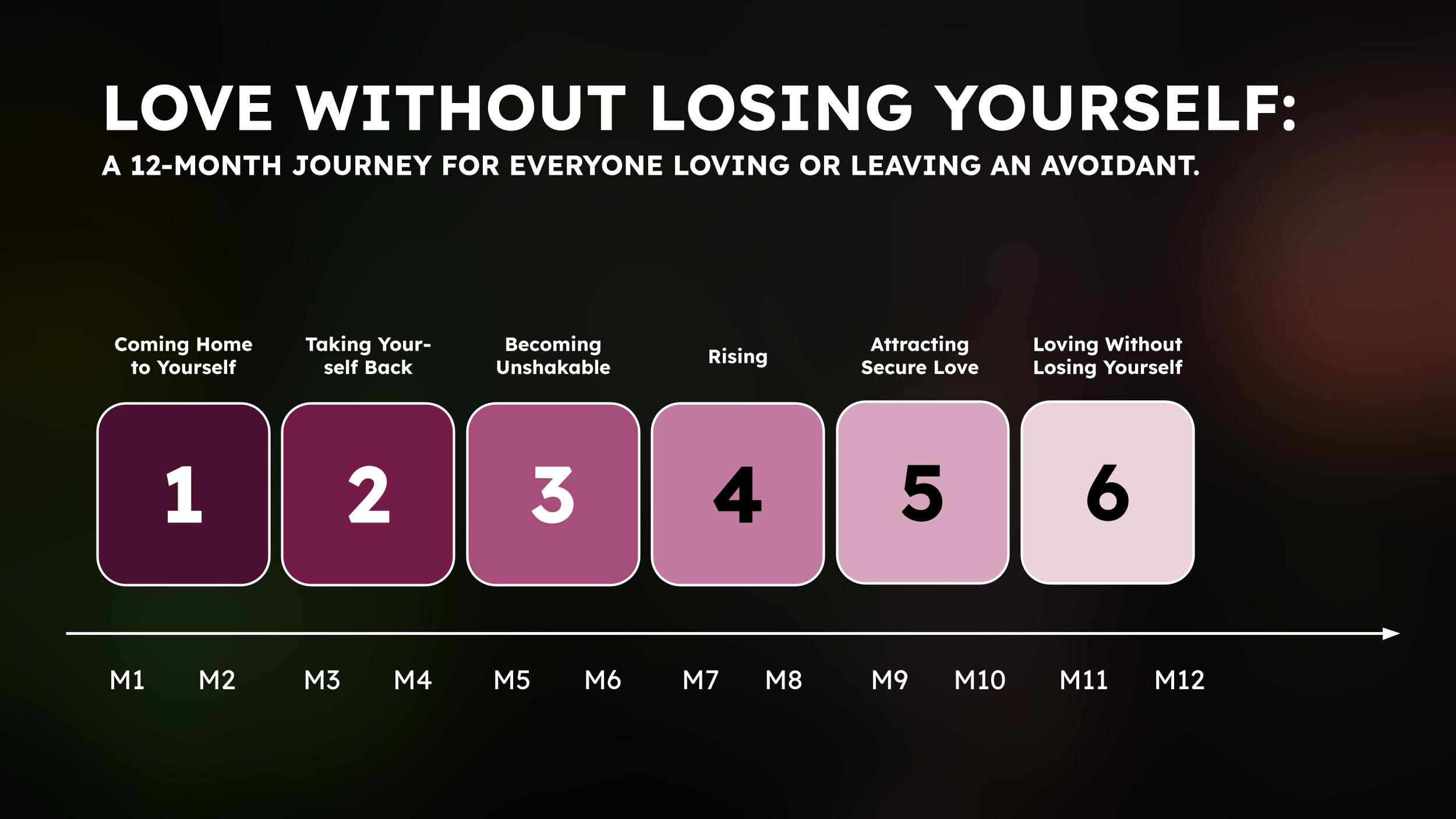
What I want to give you instead is the full path that, ideally, everyone goes through after a relationship with an avoidant. It’s how you get over this person, and how you stop ending up with the next avoidant, because you’ve built a stable sense of self from the inside. The phases come with rough time frames. Take them as orientation, because some people move faster and others need more time.
The six phases build on each other. First you come home to yourself and take yourself back. Then you become unshakable and rise again. Only after that do you start attracting secure love and, in the end, loving without losing yourself.
1. Coming Home To Yourself
This phase covers roughly the first two months after the breakup. If you’re already in no contact, no matter who ended it, you’ve taken the first step: a clear cut.
Many people in my community feel confused and weak here. Rationally, you know going back would be a bad idea. But it still feels like the connection was something special.
Yes, there were intense lows. But those highs. Maybe they really were your soulmate.
That pull can feel almost addictive, because a codependent bond has often formed: your sense of being okay got tied to this one person. One of the biggest traps here is believing that love is supposed to feel this intense. Then, when you compare it with past relationships, or later meet someone more secure, the calm feels boring. As if no fireworks meant no match.
Your thoughts may circle around them all day. Will they come back? Was it my fault? Was I crazy?
Maybe they denied things or twisted what happened, and now you don’t fully trust your own memory.
This phase is about getting your clarity back. The relationship broke under their avoidant pattern, and the bond feels so strong because it resembles how love felt when you were little.
That’s also why it felt like meeting your soulmate. But they weren’t your soulmate. They were a trauma bond partner, someone whose highs and lows hooked straight into an old wound.
Give yourself room to grieve in this phase. The sadness and the heavy feelings need space before anything else. And if the grief feels too heavy to carry on your own, please reach out to a therapist or someone you trust.
When the thought “but we had something so special” comes up, try answering it with one plain sentence: it felt so intense because it felt so familiar.
2. Taking Yourself Back
In months three and four, your most important tool is no contact, kept almost religiously. If you really want to get over your avoidant ex, this is where discipline matters.
Be prepared: somewhere between weeks 8 and 12, many people feel a strong urge to reach out again. If you give in, you keep yourself in the on-off cycle. And even if they don’t come back, your mind stays trapped in it, quietly believing there might still be a future. Maybe if one day this or that happens.
It’s the hope again, together with the addictive pull of the bond. After the grieving of the first phase, this is the time to let a little anger in. Anger helps you make a clear cut and set a boundary, with them and inside yourself.
When the urge hits, talk to a friend before you touch your phone. For me, it was that one conversation with my two friends that finally broke the spell.
3. Becoming Unshakable
In months five and six, the goal is to build a self that an avoidant can’t knock off balance anymore.
For that, it helps to understand where the pull really comes from. It’s no coincidence that you ended up with an avoidant, or that detaching feels so hard. Often there’s a deep fear of abandonment steering your behavior in the bond.
I don’t say that as criticism. It makes complete sense.
That fear makes you look for validation outside yourself, and the avoidant acted like a slot machine. Some days you got attention and love. Some days you got nothing. That’s exactly what kept you pulling the lever.
So this phase is about a sense of self that isn’t run by that fear. One where you can stand up for your own needs, and where you don’t need their validation anymore.
A picture I love for this is a chair. Many partners of avoidants end up sitting on a chair with only one leg, and that leg is the relationship. Everything else got neglected along the way: work, sports, health, hobbies, friends and family, maybe even a pet. If that one leg breaks, you hit the floor.
So build the other legs back up. Then, if a relationship ever breaks away, you’re still sitting comfortably on the rest. That’s where a stronger sense of self and real confidence come from. You want love, but you don’t need to chase it anymore.
Pick one leg this week and give it real time. Call the friend you’ve been meaning to call, or go back to the sport you dropped. When this starts to work, you’ll probably feel something new: a little distance between you and them, because you no longer rely on them for closeness and validation.
4. Rising Again
Around months seven and eight, you’re over the hill. You notice you don’t need them anymore, and that frees up energy for your own life again. What actually matters to you? What do you want next?
This is a good time to get clear on your standards for the next relationship. What does a secure person look like, and which traits do they have? And how can you spot an avoidant earlier next time, before a new bond forms where their pattern sets off yours?
Write down what you never want to accept again, and what you’d love to feel with someone instead. Keep that list. You’ll need it in the next phase.
5. Attracting Secure Love
Usually somewhere between ten months and a year after the breakup, you’re dating from a different place. Your sense of self is more solid, and you’ve learned to stand up for your needs. You date from self-worth and clear standards instead of fear of abandonment. Now you’re the one choosing what kind of partner you want in your life.
One rule helped me enormously here. I picked it up from a dating coach, and I’m usually not a big fan of dating coaches. But this rule is the perfect avoidant filter.
Don’t date anyone who’s 80 percent committed and just texts you now and then. Not 90 percent, not even 100 percent. Only people who are 110 percent in.
It helped me get over breakups with avoidants, and it helped me stop ending up with new ones.
And if someone secure feels a little boring at first, give it a chance. Calm can feel strange when you’re used to the roller coaster.
6. Loving Without Losing Yourself
This is the final phase, often one to two years after the breakup, and it’s the mission behind everything I do.
It’s about building a secure relationship with someone who may not be perfect. Maybe they’re healing too, maybe they have anxious or avoidant tendencies. But they’re willing to do the work and open to commit. And you can talk with them openly about what you need and feel.
Maybe you’re thinking: but Robert, those people are so rare. I know they’re rare. But they exist, and I know that because I’m in a relationship like that myself.
And no, I didn’t find it overnight. It took me years, and that’s okay, because I wanted to make a conscious choice.
A relationship like this should feel easy in many ways. Still, two people always bring different needs and feelings, so at some point you’ll need compromises, and you’ll need to work through conflict. If both of you are still building the inner resources for that, it takes some work.
In the relationship I believe in, both people are interdependent. Neither fully independent like the avoidant, nor codependent like an anxious partner. Both can stay with themselves, and both can lean on each other for support. The goal is an honest relationship, where real intimacy grows through honest conflict, and where both of you can love fully while keeping your own lives.
You Were Always Enough
Getting over an avoidant takes time, and it rarely happens in a straight line. Every phase brings you a little closer to yourself. You are not the problem, and you never were. So when the old hope shows up again, ask yourself gently: what would change if I stopped waiting for them to prove that I’m enough?
Want To Get Over An Avoidant Ex And Finally Move On?
I’m a recovered avoidant and created a 12-month program for everyone loving or leaving an avoidant. Your roadmap for love without losing yourself.
- 24/7 access to my AI companion for your exact situation, trained on 1 M+ words about push-pull dynamics
- 40+ guiding courses with exercises from my own therapy work
- One clear path, month by month, back to yourself