

When an avoidant partner withdraws sexually, it can feel like the most personal rejection there is. They used to want you. Now there’s always a headache or a long week. And somewhere in the back of your mind, a quiet question starts: is it me?
I want to talk about why avoidant partners withdraw sexually, and I’ll be honest from the start: this is a shame-laden topic for me too. I’ve been avoidant for most of my relationship life, and this happened in my relationships as well. So I’ll share my own experience here without any filter.
We’ll look at what happens inside an avoidant when closeness grows, and walk through the stages from the first passionate weeks to a relationship without sex. Then we’ll get to what you can actually do.
But the way back to desire may sound counterintuitive at first, because it starts with something most avoidants avoid even more than sex. We’ll get there.
The short version
- When an avoidant partner withdraws sexually, it’s almost never about you. Physically they usually work fine. An anxiety reaction in their nervous system overrides their sex drive.
- For many avoidants, closeness got tied to stress and responsibility in childhood. The closer the relationship gets, the more sex starts to feel like a to-do.
- The withdrawal often unfolds in stages: passion in the dating phase, a hot and cold roller coaster, mechanical sex and finally a drought.
- Real intimacy is more than sex. Honest conversations, and even honest conflict, are what bring desire back.
- What helps you most is taking the pressure off and coming back to yourself. And if nothing changes, you’re allowed to set a clear boundary.
Why Avoidant Partners Withdraw Sexually
Because for an avoidant, closeness and connection are tied to danger. Being in a close bond can activate their threat system, and sex is the closest form of closeness there is.
Their nervous system learned a long time ago that closeness comes with a price. To understand why, we have to go back to where it usually starts.
Where Closeness Got Tied To Danger
It usually starts in childhood, with the very first experience of closeness: the bond with mom and dad. Whenever the child expressed what they truly felt or needed, the answer was often criticism or rejection instead of comfort. Maybe a parent exploded when the child cried or wanted something.
That doesn’t mean the child was flawed. Often a caregiver was overwhelmed and stressed themselves in those first years, overworked or not sleeping properly, sometimes with narcissistic tendencies. They didn’t have the resources to calm themselves down, so they couldn’t show their child how to do it either. I don’t say this to excuse anyone, but it explains a lot.
And often it went even further. Many of these parents outsourced their emotional regulation to their child.
So the child learned two things. First: when I show my needs, I get hurt. Second: it’s my job to take care of my parent’s emotions and to meet their expectations. Those are the two core mechanisms behind what happens in the bedroom later.
So closeness never came alone. There was love, but there was also stress, and a responsibility a young child should never have to carry. My personal view is that even oxytocin, the bonding hormone that plays such a big role in physical closeness and sex, got tied to that stress reaction. And the nervous system always remembers.
Why Sex Is The Biggest Trigger Of All
Sex is exactly the opposite of what an avoidant learned about closeness. It feels best when we can let go and just flow, emotionally and physically, without expectations or responsibilities.
At the same time, sex is the purest, most naked version of closeness two people can experience. It’s the pinnacle of vulnerability. There’s probably no other moment where we feel more exposed.
That’s why the bedroom exposes avoidant attachment like nothing else. Both of their big triggers come together there: the fear of being crushed by expectations, and the fear of showing themselves vulnerable.
Want To Know What Helps When They Stop Desiring You?
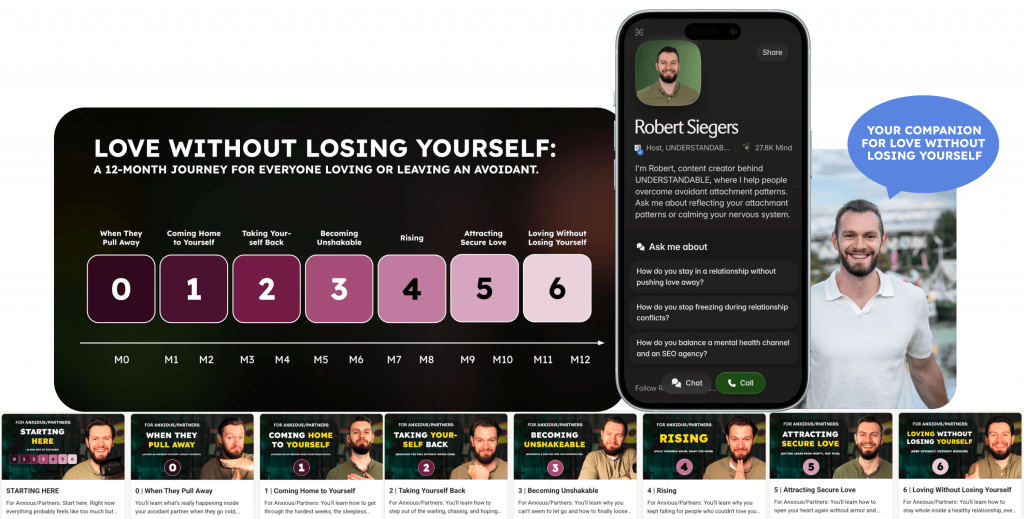
I’m a recovered avoidant and created a 12-month program for everyone loving or leaving an avoidant. Your roadmap for love without losing yourself.
- 24/7 access to my AI companion for your exact situation, trained on 1 M+ words about push-pull dynamics
- 40+ guiding courses with exercises from my own therapy work
- One clear path, month by month, back to yourself
How Avoidant Attachment Shows Up In The Bedroom
The loss of desire rarely happens overnight. It happens step by step, and in my experience it usually moves through four stages.
I walk through these stages, and why the bedroom exposes avoidant attachment, in this video:
1. The Dating Phase
Stage zero is the dating phase, and here avoidants usually don’t have a problem at all. There are no expectations yet and no commitment. Nobody asks them to show their vulnerable needs. So emotions flow, and the avoidant often performs at their best.
This is where you feel truly desired and attractive. They shower you with love and affection, and the sex feels really great. That’s also why many avoidants do so well with short-term affairs or friends with benefits.
Of course, part of it is that they think you’re amazing, which I’m sure you are. But they’re also driven by an old anxiety and an old hope: to finally find someone who takes them as they are, with all of their vulnerable parts. It’s the missing puzzle piece I describe in my article on avoidant breadcrumbing.
2. The Roller Coaster Phase
Stage one begins when things get more serious. Maybe after a few months you ask: do we have a future together? Are we a couple? Commitment grows, and the first conflicts come up.
We all bring our needs and standards into a relationship, so now there’s something to negotiate. For the avoidant, that’s exactly when closeness starts to feel overwhelming, because it reminds them of the expectations they carried as a child. And the closer the bond gets, the stronger their anxiety becomes.
Put simply, once the rose-colored glasses come off, the feel-good side goes down and the stress side goes up: fewer bonding and reward hormones, more cortisol. Their reward system slowly starts to shut down. What you notice is that they get a little more distant, and sex becomes less frequent and irregular.
But when it does happen, it feels incredibly intense. Maybe better than ever.
That’s the hot and cold rhythm. You have a fight because your needs feel unmet. They feel the pressure and withdraw for a few days, and you’re left hurt and disappointed.
Then they come back, and the sex is so intense you might ask yourself: was sex ever that good, even with my exes? This is the classic anxious-avoidant pattern, and if you’ve mostly been with avoidants, it might just feel normal to you.
3. The Mechanical Phase
Stage two often starts somewhere between three months and a year into the relationship. Sex becomes rare, and when it happens, it feels mechanical. The emotional connection you used to have is missing. It can feel like having sex with a robot.
And the excuses start. A headache today. Overworked tomorrow. And on the weekend they need to recover from all that stress.
Here’s what I really want you to understand: physically, they usually work just fine. What switches off their desire is an anxiety reaction in their nervous system, strong enough to override their sex drive.
Most avoidants I’ve met have no problem with masturbation or getting aroused on their own. They just can’t live their sexuality inside the relationship while that anxiety is present. And if you’re ever unsure whether something physical is going on, a doctor can rule that out.
Many repress their needs and escape into work or hobbies. For some it’s porn, which can turn into a real addiction and is a very shame-laden topic in itself. For some it’s affairs. Not all avoidants, of course, and I personally have never cheated.
But many look for some way to express a sex drive that has no place in the relationship anymore. At least until they realize that the problem lies in their own triggers and attachment wounds.
At the same time, they feel disconnected inside. They go distant and stop sharing anything vulnerable. Step by step, they go cold.
4. The Drought
Stage three is the peak: the drought. Sex isn’t part of the relationship anymore.
For the avoidant, sex now feels entirely like a to-do. An expectation. A responsibility to satisfy you. And that stresses them, because it feels exactly like it felt with their caregivers back then, when they had to take care of someone else’s mood.
They feel crushed by expectations and afraid to show themselves vulnerable at the same time. So when it comes to intimacy, they turn off completely.
Why It Feels So Personal, Even Though It Isn’t
And you? You feel massively undesired. Maybe even invisible, as if you didn’t exist for them anymore.
So you start questioning yourself. Did I gain weight? Am I not attractive anymore? Did I age too fast?
I want you to hear this clearly. It’s not about you, and it never has been about you. Not at a single point. You are attractive, and you are desirable.
Their withdrawal comes from old expectations and from the overwhelm that closeness triggers in them. In their mind, they’re reliving the relationship with a caregiver that was exhausting and probably hurtful.
I say this with a bit of sadness, because I see it in myself too. Sometimes I still lose desire and can’t express it, because I’m busy regulating myself. It was present in all of my earlier relationships, and for most of them, I didn’t understand why it was happening to me.
So yes, the loss of desire comes from their side. But they suffer too, often quietly and with a lot of shame.
Something else often happens on your side. You don’t go cold. You desire them even more, because sex became rare. It’s the same effect as gambling: you rarely win, so you keep pressing that machine, waiting for the next good feeling.
What Real Intimacy Actually Means
Have you ever noticed that make-up sex after a conflict can feel so much better than usual? There’s a reason for that. Honest conflict brings back the emotional connection that’s missing when sex becomes mechanical.
Intimacy is not just sex, cuddling or closeness. It’s the shared reality between two truly authentic selves.
That means both of you show up vulnerable, emotionally naked as well as physically. Can you both share what you deeply need and feel? Is there room for honest conflict?
When that happens, you both get pulled into each other’s inner worlds. The goal is to share conflict while fully respecting each other. That emotional intimacy is missing in most anxious-avoidant couples, and without it, desire slowly drains out of the relationship.
My first therapist always told me: when two fully reflected, aware people share their insecurities and vulnerabilities with each other, the sex afterwards will be amazing.
Reflecting on my own experience, I came to one conclusion: the true reason for a loss of sexual attraction is that not enough emotional intimacy is present. And that’s true far beyond the bedroom. It shapes the whole relationship with an emotionally unavailable partner.
I know that sounds counterintuitive. More conflict and more deep conversations? But that’s what brings desire back. And it’s exactly what the avoidant partner tries to avoid the most.
As a recovered avoidant who worked with four different therapists, I understood this at some point. But most avoidants need a lot of time to get there. You can’t force instant vulnerability or honest conflict with someone who isn’t aware of their pattern yet. What you can do is prepare yourself and the relationship for it.
Want To Know What Helps When They Stop Desiring You?
I’m a recovered avoidant and created a 12-month program for everyone loving or leaving an avoidant. Your roadmap for love without losing yourself.
- 24/7 access to my AI companion for your exact situation, trained on 1 M+ words about push-pull dynamics
- 40+ guiding courses with exercises from my own therapy work
- One clear path, month by month, back to yourself
What To Do When Your Avoidant Partner Withdraws Sexually
These are the steps I’d focus on, from my own experience and from what I learned in therapy. You can start with the first ones today.
I also talk through how to react in this video:
1. Take The Pressure Off
Right now, sex feels like a to-do for them, a responsibility to satisfy you. The chasing impulse they had when you first met is gone. Instead, they feel you chasing them.
And when they feel chased, they shut down. So the first thing to remove is pressure, and to let them find their way back into that chasing mode.
In practice, that can mean letting physical closeness exist without it having to lead anywhere. A hug or a quiet evening on the couch, with no hidden expectation behind it.
2. Stop Taking It Personally
I see so many partners who believe: if they lose attraction, if they go cold, they must have a problem with me. I must have done something wrong. That’s not the case.
One or both of your partner’s caregivers, maybe 20 or 30 years ago, couldn’t meet that child’s needs with compassion and understanding. That has nothing to do with you.
So make it clear for yourself and write it down: it’s not about me. I am attractive as I am. If they found you attractive before, that feeling is still there. It’s just buried under all of their anxieties right now.
3. Come Back To Yourself
Shift the focus back to yourself. Instead of thinking about what’s going on in them, be with yourself.
Here’s another honest truth about every push-pull relationship: being with an avoidant partner means learning, like no other lesson, to regulate your own nervous system. It’s a challenge. But if it isn’t completely burning you out, you can see it as an opportunity, because every relationship brings us a lesson.
Ask yourself: how can I stay connected with myself while there is chaos around me?
In practice, that means rebuilding your sense of self outside the relationship, so that what happens in the bedroom isn’t tied to your worth anymore. I describe this with the picture of a chair with only one leg in my article on how to get over an avoidant.
4. Open The Door To Emotional Intimacy
Once the pressure is lower, you can start inviting honest conversations. Begin with what’s going on in you, so it doesn’t land as an accusation.
Something like: “I miss feeling close to you. I’m not blaming you. I’d really like to understand what’s happening for you.”
Be patient with their pace. For most avoidants, awareness comes first, and that can take time.
5. Know Your Boundary
Every push-pull relationship also teaches you about boundaries. How much can you actually tolerate? How much time can you give them to get to the point where they can open up and be vulnerable with you?
If you can’t tolerate it anymore, then you also have your answer. You deserve someone who treats you with love and respect, and who desires you. You can’t control the other person, and you can’t force them to open up. If they’re not willing to work on it, that’s information too, and you’re allowed to set a clear boundary.
If setting that boundary scares you because you’re afraid to lose them, you might be abandoning yourself right now. I did that for a long time in my first relationships. Learning to set clearer boundaries and to express my needs was something I worked on with my first therapist.
And if the relationship can’t be saved, you can still take something valuable from it: a clearer sense of what you need.
If You’re The Avoidant One
Maybe you’re reading this from the other side. Then the first step is awareness. Many avoidants believe they’ve genuinely lost interest and attraction, and they’re confused: why am I losing attraction to my partner when I still have a sex drive?
What’s happening is an old trauma pattern, and it can change. The way back to sexual intimacy runs through emotional intimacy. That can start with a sentence like this:
“I feel so ashamed that I’m somehow losing desire. Sometimes I feel triggered, and when we have a conflict, I feel really insecure and sensitive inside.”
You Deserve To Be Desired
When the bedroom goes quiet, it’s easy to make it about your worth. But you are desirable, and you always have been. You deserve someone who desires you and can show it. So the next time the silence gets loud, ask yourself: what would help me feel at home in myself tonight, whatever happens or doesn’t happen between us?
Want To Know What Helps When They Stop Desiring You?
I’m a recovered avoidant and created a 12-month program for everyone loving or leaving an avoidant. Your roadmap for love without losing yourself.
- 24/7 access to my AI companion for your exact situation, trained on 1 M+ words about push-pull dynamics
- 40+ guiding courses with exercises from my own therapy work
- One clear path, month by month, back to yourself